
New York DMV Permit Practice Test 36
- Questions20
- Correct to pass14
- Passing score70%
- Minimum age16 years
-
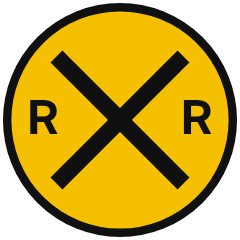
1. Where is this sign installed in relation to the hazard it announces?
Show answer
Answer A: Far enough before the hazard that a driver can slow down and stop short of it
This is an advance warning sign, placed on the approach so a driver has time to react before reaching a crossing that a curve or a crest may be hiding.
-
2. A curb sign reads 2 Hour Parking, 8 AM to 6 PM, Monday to Saturday. When may you stay longer than two hours?
Show answer
Answer A: Outside those hours and on Sundays
A time limit applies only during the days and hours printed on the sign; outside them the ordinary parking rules apply.
-
3. You are parked legally, but a police officer tells you to move the vehicle. What should you do?
Show answer
Answer B: Move it as directed, because an officer overrides the signs
Directions from a police officer or a firefighter take precedence over signs and markings, whether they are directing traffic or clearing a street.
-
4. Why is it useful to watch the vehicle two or three places ahead of you?
Show answer
Answer C: You get an earlier warning of slowing traffic than brake lights give
Trouble travels back through a line of traffic, so seeing it start several vehicles ahead gives you a head start on braking.
-
5. How should you position your vehicle for a right turn from a two-way street?
Show answer
Answer B: As close as practical to the right curb or edge, then turn into the nearest right lane
Right turns are made from the lane nearest the right edge into the nearest available lane, which keeps the turn tight and prevents a wide sweep into other traffic.
-
6. What may a New York junior license holder do upstate between 5 a.m. and 9 p.m.?
Show answer
Answer A: Drive without being accompanied
Junior license restrictions vary by region: upstate, between 5 a.m. and 9 p.m., the junior driver may drive unaccompanied, while between 9 p.m. and 5 a.m. the trip must be to work or a school course or be supervised.
-
7. You have to leave a trailer parked on a slope. What extra step protects it?
Show answer
Answer D: Chock the trailer wheels as well as setting the brake
Chocks physically block the wheels, which is the only thing that still holds if a brake or a coupling lets go.
-
8. You stop at the curb on a busy street to let passengers out. What should you tell them?
Show answer
Answer A: To get out on the curb side, away from traffic
Passengers should always leave on the side away from moving traffic, which keeps both them and the door out of the travel lane.
-
9. You see smoke coming from under the hood while driving. What should you do?
Show answer
Answer D: Signal, pull well off the road, shut off the engine and move everyone away from the vehicle
Stopping and shutting off the engine cuts the fuel supply to a possible fire, and distance protects you if it spreads. Raising the hood can feed the fire a rush of air.
-
10. You stop at a rest area because you are sleepy. How long a nap is usually recommended?
Show answer
Answer D: About fifteen to twenty minutes
A short nap of fifteen to twenty minutes restores useful alertness without leaving the grogginess a longer sleep can bring, and you should wait a few minutes before driving on.
-
11. In near freezing weather, which part of an otherwise clear road is most likely to still be icy?
Show answer
Answer D: A shaded dip under trees or beside a rock cut
Sun clears most of the road, but shaded hollows never warm up and can hold ice long after the rest of the pavement is dry.
-
12. In heavy fog at night on a rural two-lane road, which marking best helps a driver hold position?
Show answer
Answer C: The solid white line along the right edge
Steering by the right edge line keeps a driver clear of oncoming traffic, while watching the center line tends to pull the vehicle toward it.
-
13. What does the New York Move Over law require on a multi-lane controlled-access highway?
Show answer
Answer D: Reducing speed and moving out of the lane next to the stopped vehicle when it can be done safely
Drivers must reduce speed near any stopped emergency or hazard vehicle showing its lights, and on parkways, interstates and other controlled-access roads with multiple lanes they must also vacate the adjacent lane when it is safe.
-
14. The curb ahead is signed as a bus stop. May you wait there with your vehicle?
Show answer
Answer C: No, the space must stay clear for buses
A bus stop must stay open so that a bus can reach the curb and let passengers on and off safely, so no other vehicle may occupy it.
-
15. Which color of warning light identifies a tow or recovery vehicle under New York's Move Over law?
Show answer
Answer D: Amber, or a combination of blue and amber
New York's Move Over law identifies tow and recovery vehicles by amber lights, or a combination of blue and amber lights.
-
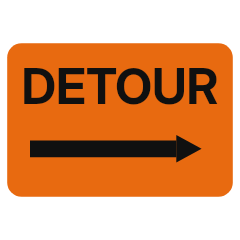
16. Once a driver has joined the route this sign begins, how is the rest of the way marked?
Show answer
Answer B: By further markers of the same kind at each turn, until the original road is rejoined
The alternate route is signed continuously, with a marker at every turn, so a driver with no local knowledge can follow it back to the original road.
-
17. You and an oncoming driver are both turning left at the same intersection. What is the usual rule?
Show answer
Answer D: Both turn in front of each other unless markings show otherwise
The normal practice is to pass driver side to driver side, turning in front of one another, unless pavement markings or signs direct a different path.
-
18. What must a driver on a parkway or controlled-access highway do, in addition to changing lanes, when passing a vehicle stopped near the shoulder under New York's Move Over law?
Show answer
Answer D: Continue to comply with all standard traffic laws while making the lane change
New York's Move Over law requires that any lane change made to pass a stopped vehicle still comply with all ordinary traffic laws, such as signaling and checking for other traffic.
-
19. You have just merged onto a freeway from an entrance ramp. What should you do next?
Show answer
Answer C: Settle into the right lane and build up speed before changing lanes
Crossing lanes while you are still below the speed of the traffic forces other drivers to brake, so the speed comes first and the lane change second.
-
20. What must a New York driver do when a school bus flashes its red lights on a divided highway?
Show answer
Answer B: Stop even when approaching from the opposite side, at least 20 feet away
New York requires traffic from both directions to stop for a bus with flashing red lights, including on a divided highway, and drivers should stop at least 20 feet from the bus.