
New York DMV Motorcycle Practice Test 11
- Questions20
- Correct to pass14
- Passing score70%
- Minimum age16 years
-
1. How should a rider take curves while carrying a passenger?
Show answer
Answer A: More slowly than when riding alone
The extra weight raises the center of gravity and makes the motorcycle respond more slowly, so curves have to be taken at a lower speed.
-
2. Where should a rider in the middle of a group direct their attention?
Show answer
Answer A: Well ahead through the group and around it, not just at the rider in front
Watching only the machine ahead hides the traffic and hazards further up the road, and it leaves the rider reacting late to everything the group meets.
-
3. What most often leads to an engine seizure on a motorcycle?
Show answer
Answer A: Loss of engine oil or coolant, so the moving parts overheat and grip
Seizure is normally a lubrication or cooling failure, which is why oil level and coolant are part of every pre-ride check and why a rising temperature reading deserves attention.
-
4. How should a face shield be cleaned?
Show answer
Answer C: With mild soap and water and a soft cloth, then dried gently
Plastic shields scratch easily and are damaged by solvents, and a scratched shield scatters light badly at night, so use mild soap, water and a soft cloth.
-
5. The overhead signal above your lane changes to a steady yellow X. What should you do?
Show answer
Answer B: Prepare to move out of that lane
A steady yellow X warns that the lane is about to close, so drivers should get ready to vacate it in favor of an open lane.
-
6. How long should a head check before a lane change last?
Show answer
Answer D: A quick glance, so you do not lose track of what is happening ahead
Traffic ahead can change in a second, so the blind spot check is a fast glance and the rider returns attention to the road immediately.
-
7. A driver extends the left arm out the window and points it downward toward the road surface. What is being signaled?
Show answer
Answer A: Slowing down or stopping
The left arm extended downward is the standard hand signal for slowing or stopping.
-
8. A driver who is passing you cannot complete the pass because a vehicle is coming. What should you do?
Show answer
Answer C: Ease off the accelerator and make room for them to drop back in
The only place for the passing vehicle to go is the gap behind you, and easing off opens that gap immediately.
-
9. You are already inside an intersection when you realize you should be in the lane beside you. What should you do?
Show answer
Answer C: Stay in your lane through the intersection and change lanes afterwards
Drivers in an intersection are watching for cross traffic and turning vehicles, so an unexpected sideways move there is easily missed.
-
10. You are approaching a refuse collection truck working along your street. What should you expect?
Show answer
Answer D: Workers stepping into the road around the truck
Collection crews move constantly between the truck and the curb, often from where you cannot see them, so slow right down and pass only when the whole area is clear.
-
11. A driver is following you far too closely. What is the best response?
Show answer
Answer D: Increase your own following distance and let the driver pass when it is safe
More room ahead of you means you can slow gradually instead of braking hard, which reduces the chance of being struck from behind, and letting the driver by removes the problem entirely.
-
12. Why is parking next to a fire hydrant or in a marked fire lane prohibited?
Show answer
Answer D: It would delay firefighters who need immediate access to the hydrant or the building
Fire hydrants and fire lanes must remain clear at all times so emergency crews can connect hoses and reach a building without delay.
-
13. What is the purpose of the padding built into the shoulders, elbows and knees of riding gear?
Show answer
Answer C: It absorbs impact energy at the joints most likely to strike first
Armor at the joints spreads and absorbs the force of an impact in the places that usually hit the ground first in a fall.
-
14. A large panel mounted on a trailer at the roadside displays a flashing arrow pointing left. What does it tell you?
Show answer
Answer B: Move into the lane to your left
An arrow panel directs traffic out of a closed lane, so the arrow shows the direction you must move rather than the shape of the road ahead.
-
15. You approach a traffic signal that has already been green since it first came into view. What should you expect?
Show answer
Answer B: That it may change at any moment, so be ready to stop
A signal already green when you first see it is well into its cycle, so a rider covers the brakes and plans a stop rather than assuming a clear run.
-
16. A driver ahead brakes for no reason you can see, again and again. What should you do?
Show answer
Answer B: Increase your following distance and be ready for yet another stop
Unexplained braking tells you the driver is unsure or distracted, so the safe answer is more room, not less.
-
17. You have just returned to your own lane after passing. Why should you not slow down straight away?
Show answer
Answer A: The vehicle you passed is close behind and needs room to stop
Returning and then braking leaves the driver you just overtook with almost no following distance, which is how a pass turns into a rear-end collision.
-
18. On a narrow residential street, why does parking tight against the curb matter so much?
Show answer
Answer C: Because fire trucks and ambulances need the width to get through
Cars parked even a foot out from the curb on both sides can narrow a street until a fire truck or ambulance cannot pass.
-
19. A sign reads MINIMUM SPEED 40. What does it require of a driver?
Show answer
Answer C: Not to drive below that speed when conditions allow
A minimum speed limit keeps unnecessarily slow vehicles from obstructing traffic, but it never overrides the duty to slow down for weather or congestion.
-
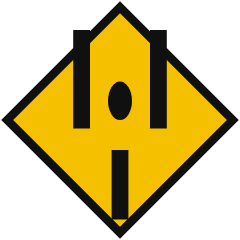
20. What change in the road does this sign announce?
Show answer
Answer B: The two directions of travel are about to be separated, and the driver must keep to the right of the separation
Ahead the roadway splits into separate one-way roadways on either side of a median, so the driver stays to the right of the divider and no longer meets oncoming vehicles.