
New York DMV Motorcycle Practice Test 17
- Questions20
- Correct to pass14
- Passing score70%
- Minimum age16 years
-
1. You have just had bad news and you feel very upset. What should you do?
Show answer
Answer B: Wait until you have calmed down, or else let somebody else drive
Strong emotion takes attention away from the road as surely as alcohol or fatigue, so it is a reason not to drive yet.
-
2. You are pulling away from a stop with a passenger for the first time. What should you expect?
Show answer
Answer D: You will need a little more throttle and a slower clutch release
The extra weight makes the motorcycle harder to get rolling, and a rushed clutch release with a passenger aboard is a common way to stall or lurch.
-
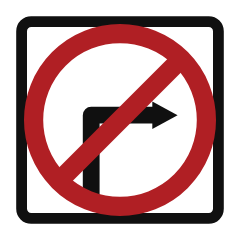
3. A driver stopped at a red signal wants to turn right and this sign is posted at the corner. What is permitted?
Show answer
Answer A: Nothing: the turn is barred whether the signal is red or green
The restriction works independently of the signal, so the usual permission to turn right after stopping at a red light does not exist where this sign is posted.
-
4. Where is the oil and grease strip in a lane usually widest and most slippery?
Show answer
Answer D: At toll plazas, bus stops and intersections where vehicles sit and idle
Oil and coolant drip most where vehicles stop, idle and pull away, so the center strip is widest and slickest at toll booths, bus stops and busy intersections.
-
5. Where is a road work ahead sign placed?
Show answer
Answer B: In advance of the work space or detour, so drivers are warned before reaching it
Advance warning signs are placed upstream of the work space or detour so that drivers have time to slow down and change lanes before reaching the activity.
-
6. On loose gravel or deep fresh snow, how does an antilock system affect the stopping distance?
Show answer
Answer D: It can lengthen it, although you keep the ability to steer
On loose surfaces a locked wheel piles up a wedge of gravel or snow that helps it stop, so the antilock stop can be longer even though steering still works.
-
7. Which combination best reduces the chance of hydroplaning?
Show answer
Answer D: Good tread depth, correct tire pressure and lower speed in the rain
Tread channels water away, correct pressure keeps the tire's shape, and lower speed gives the tire time to push water aside. Hydroplaning can begin at surprisingly modest speeds.
-
8. In a work zone the temporary lane lines conflict with the old lines still visible on the pavement. Which do you follow?
Show answer
Answer C: The temporary markings, which show the current traffic pattern
Temporary markings define the traffic pattern in force, and the old lines are simply the layout that no longer applies.
-
9. Why do safety agencies put head protection first among riding gear?
Show answer
Answer A: Because head injuries are the leading cause of death in motorcycle crashes
Head injury is the most common cause of death in motorcycle crashes, which is why a certified helmet is the single most important piece of gear.
-
10. Which statement best describes what the basic speed law requires of you?
Show answer
Answer C: That you never drive faster than is reasonable and safe for the conditions
Nearly every state has a basic speed law that makes the conditions the real limit: weather, traffic, light and road surface can all require a speed well below the posted number.
-
11. When is it safe to return to your own lane after passing a vehicle?
Show answer
Answer C: Once you can see the whole front of that vehicle in your mirror
Seeing the entire front of the vehicle in the mirror proves there is a full vehicle length of clear road, which the rider cannot judge by feel alone.
-
12. You reach a stretch of road covered by moving flood water of unknown depth. What is the correct decision?
Show answer
Answer D: Turn around and take another route
About a foot of moving water is enough to carry away most cars, and the roadbed under the water may already be washed out, so the only safe choice is to turn around.
-
13. You leave a brightly lit service area onto a dark rural road. Why should you slow down for a while?
Show answer
Answer C: Your eyes need time to adjust, so at first you see less
Eyes take a few minutes to adapt from bright light to darkness, and during that time you can see much less than your headlights actually show.
-
14. Before making a right turn at an intersection, what should you check besides oncoming traffic?
Show answer
Answer B: Your right blind spot and the crosswalk, for cyclists and pedestrians
Right turns often catch a cyclist or a pedestrian coming up on the right, so check the blind spot and the crosswalk before you turn.
-
15. You stop behind another vehicle at a traffic light. How much space should you leave?
Show answer
Answer D: Enough to see where its rear tires touch the pavement
Seeing the rear tires on the road leaves room to steer around the vehicle if it stalls, and gives a cushion if you are struck from behind.
-
16. A crash happens directly in front of you and vehicles are blocking both lanes. What should you do?
Show answer
Answer B: Stop at a safe distance, put on the hazards and warn the traffic behind
The greatest danger after a crash is a second collision, so stop short of it and make sure the traffic behind you can see the problem.
-
17. Which headlight setting should you use in dense fog?
Show answer
Answer B: Low beams
High beams reflect off the water droplets in fog and bounce glare back at you, while low beams aim downward and light the road without that mirror effect.
-
18. What is sensible when you drive in an unfamiliar town for the first time?
Show answer
Answer C: Drive a little slower and give yourself more time to read the signs
In unfamiliar surroundings you need longer to take in signs, junctions and markings, and lower speed buys that time.
-
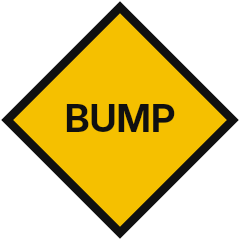
19. How should a driver respond to this sign?
Show answer
Answer C: Slow down before reaching the rough spot and cross it at a steady, low speed
Losing speed before a sharp rise in the pavement keeps the vehicle settled, while braking or accelerating on top of it unsettles the suspension and costs grip.
-
20. Permanent signs must be retroreflective or lighted so that
Show answer
Answer A: they show the same shape and color at night as by day
Retroreflective sheeting throws headlight light back to the driver, so a sign keeps its daytime shape and color after dark.