
New York DMV Motorcycle Practice Test 29
- Questions20
- Correct to pass14
- Passing score70%
- Minimum age16 years
-
1. Children are playing close to the edge of a residential street. What is the right speed choice?
Show answer
Answer D: Well below the limit, slow enough to stop for a sudden dash
Children can step out without warning, so the safe speed is the one that lets you stop within the distance you can see to be clear.
-
2. An officer directing traffic faces you and holds one hand up with the open palm toward your vehicle. What does the gesture mean?
Show answer
Answer D: Stop before reaching the officer
A raised open palm shown toward a driver is the standard signal to stop.
-
3. You arrive at an intersection where the traffic signal is completely dark because of a power failure. How should you proceed?
Show answer
Answer C: Treat the intersection as an all-way stop
When a signal shows no indication at all, drivers on every approach must stop and then take turns, exactly as at an all-way stop.
-
4. Where among these is parking specifically prohibited?
Show answer
Answer A: On a bridge, in a tunnel or on railroad tracks
Bridges and tunnels have no safe refuge and cannot be widened, and a vehicle left on railroad tracks cannot be avoided by an approaching train.
-
5. How should the mirrors be set before setting off?
Show answer
Answer B: So that each mirror shows the lane behind and part of the lane beside
Mirrors aimed too far inward show mostly the rider, wasting the view that is meant to cover the traffic behind and to the side.
-
6. A driver waiting to turn left appears to be looking straight at you. What should you assume?
Show answer
Answer C: That the driver may still not have seen you, and may turn across your path
Drivers look toward motorcycles without registering them, so eye contact is not evidence that the rider has been seen and no plan should depend on it.
-
7. The added lane warning sign tells a driver that
Show answer
Answer A: an extra lane begins ahead, so entering traffic does not have to merge into an existing lane
Where a lane is added, traffic entering the roadway gets a lane of its own, so merging is not required, although drivers should still watch the vehicles beside them.
-
8. A group in formation needs to change lanes. What is the safest way to do it?
Show answer
Answer A: The leader starts the change early enough for the whole group to complete it
Beginning the change early gives the entire formation the road and the time it needs to move over together instead of scattering across two lanes.
-
9. When is the right time to put on rain gear?
Show answer
Answer C: Before the rain reaches you, at a safe place off the roadway
Once you are wet you stay cold for the rest of the ride, so stop somewhere safe and put the rain suit on while you are still dry.
-
10. A passenger is getting on at the roadside. Which side should they use if the exhaust and the sidestand allow it?
Show answer
Answer B: The side away from moving traffic, clear of the hot exhaust
Getting on and off away from passing vehicles keeps the passenger out of traffic, and the side chosen must also keep their leg clear of the hot exhaust.
-
11. What is the main danger of grabbing the front brake lever abruptly?
Show answer
Answer D: The front wheel can lock, and a locked wheel cannot steer or balance
The front brake must be squeezed progressively so that weight transfers onto the front tire before full braking force is asked of it.
-
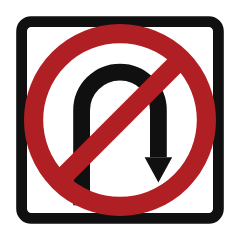
12. A driver who wants to reverse direction arrives at this sign. What is allowed?
Show answer
Answer C: Going on and reversing direction only where the maneuver is permitted
The restriction removes that maneuver at that spot entirely, so the driver has to continue and turn the vehicle around at a place where it is not prohibited.
-
13. How should a passenger behave through a turn?
Show answer
Answer B: Look over the operator's shoulder in the direction of the turn and avoid sudden movement
Looking over the operator's shoulder into the turn keeps the passenger aligned with the motorcycle, and avoiding sudden movement prevents unexpected changes in balance.
-
14. According to New York's speeding fine schedule, what is the fine range for driving more than 30 mph over the posted limit?
Show answer
Answer A: $180 to $600
New York's speeding fine schedule sets a range of 180 to 600 dollars for driving more than 30 mph over the posted limit, the steepest of the three brackets.
-
15. The rider ahead of you has just passed a slow vehicle on a two lane road. What does that tell you about your own pass?
Show answer
Answer C: Nothing, because you must judge the oncoming traffic yourself
Every pass uses up part of the gap, so the space that was ample for the rider ahead may be far too short by the time it is your turn.
-
16. You come to a place where a storm has dropped a power line across the road ahead. What should you do?
Show answer
Answer B: Stop well back, keep everyone away from it and report it to the police
A downed line may be live and can energize the ground around it, so keep well clear and let the utility or the police handle it.
-
17. An entrance ramp joins a highway just before an exit ramp leaves it. What should you expect in that short section?
Show answer
Answer D: Vehicles crossing paths as some enter and others leave
In a weaving section entering traffic moves left while exiting traffic moves right over the same short stretch, so lane changes there need extra room and extra care.
-
18. Beyond emergency vehicles, which other vehicle type does New York's Move Over law specifically identify by its amber warning lights?
Show answer
Answer A: A hazard vehicle marked with amber lights
New York's Move Over law names hazard vehicles displaying amber lights, alongside tow and recovery vehicles and snow and ice removal vehicles, as protected road users.
-
19. Two solid white lines separate your lane from the lane beside it. What do they mean?
Show answer
Answer B: Crossing from one lane to the other is prohibited
A solid double white line marks a boundary that road users may not cross, such as the entrance to a preferential lane.
-
20. An obstacle appears ahead and you can see there is no room left to stop before it. What should you do?
Show answer
Answer D: Swerve around it
Once the distance is too short to stop, changing direction is the only option left, and a motorcycle can change direction faster than it can stop.