
New York DMV Motorcycle Practice Test 31
- Questions20
- Correct to pass14
- Passing score70%
- Minimum age16 years
-
1. What does a yield sign require of a driver?
Show answer
Answer A: Slow down, and stop when necessary, so conflicting traffic can go first
A yield sign obliges the driver to reduce to a speed suited to conditions and to stop when needed so that conflicting traffic or pedestrians are not interfered with.
-
2. When may a New York motorcycle operator ride without approved eye protection?
Show answer
Answer B: Never, because eye protection is required even with a windshield
New York requires approved eye protection meeting the ANSI Z87.1 standard for every operator, even if the motorcycle is fitted with an approved windshield.
-
3. Which sign shape is reserved for one message only, the requirement to stop?
Show answer
Answer A: The octagon
The octagon is used for the stop sign and for no other message, so the outline alone identifies the requirement even when the legend is hard to read.
-
4. A person with a guide dog is standing at the corner facing the street you are about to cross. What should you do?
Show answer
Answer D: Stop well back and wait quietly for them to decide
Blind pedestrians rely on engine sound to judge traffic, so stop back from the crossing and avoid the horn, which only confuses them.
-
5. In most states, when are headlights required apart from times of poor visibility?
Show answer
Answer A: From about half an hour after sunset to half an hour before sunrise
Most states require lights from about half an hour after sunset until about half an hour before sunrise, and some simply say sunset to sunrise; lights are also required whenever visibility is poor.
-
6. After an hour on a hot highway your tire pressure reads higher than it did in the morning. What should you do?
Show answer
Answer D: Nothing, because pressure rises when tires heat up
Air expands as the tire warms, so a hot reading is normally above the cold setting. Bleeding air off would leave the tire underinflated once it cooled.
-
7. You have had to leave the pavement onto a loose gravel shoulder and now need to stop. How should you brake?
Show answer
Answer D: Use both brakes gently and evenly, expecting a much longer stopping distance
Loose gravel cuts available traction sharply, so apply both brakes lightly and smoothly and allow far more room than you would need on pavement.
-
8. A yellow horizontal rectangular sign showing one large arrow pointing left or right, facing traffic on the far side of a sharp bend, tells the driver
Show answer
Answer C: which way the roadway turns at that point
The large arrow sign is mounted on the outside of a sharp change in alignment so that a driver approaching head on immediately sees which way the road goes.
-
9. The light turns yellow when your front wheels are already past the stop line inside the intersection. What should you do?
Show answer
Answer B: Keep going and clear the intersection without speeding up
Once you are legally in the intersection the safest and correct action is to continue through and clear it, without accelerating.
-
10. You are crossing a divided highway with a wide median. How should you treat the two roadways?
Show answer
Answer D: As two intersections, waiting in the median only when your vehicle fits
Each roadway of a divided highway is a separate intersection, and you should wait in the median only if it is long enough to hold your vehicle clear of both roadways.
-
11. A rider in the middle of the group pulls over onto the shoulder. What should the sweep rider do?
Show answer
Answer C: Stop and stay with that rider while the rest of the group continues
The sweep exists so that no rider is ever left alone at the roadside, while the remainder of the group carries on to a safe place to wait.
-
12. You have a green arrow to turn left. What still applies?
Show answer
Answer D: You must yield to any pedestrian or vehicle still inside the intersection
A green arrow protects your turn from conflicting traffic, but you must still let anyone already in the intersection get clear before you move.
-
13. A steady downward green arrow is displayed over a lane. What does it indicate?
Show answer
Answer C: The lane is open to traffic in your direction
A steady downward green arrow means the lane it points to is open to traffic traveling in your direction.
-
14. Your passenger wants to carry a bag in one hand during the ride. What should you tell them?
Show answer
Answer B: No, both hands are needed to hold on, so the bag must be secured on the machine
A passenger needs both hands on the operator or the handholds, and anything carried loose can be dropped into the wheel or pull the passenger off balance.
-
15. What is the purpose of carrying a first aid kit in your vehicle?
Show answer
Answer D: It lets you treat cuts and bleeding while the help is on its way
A kit is for simple first aid such as controlling bleeding until trained help arrives, not a substitute for calling for that help.
-
16. The rider who was behind you has vanished from your mirrors. What should you do?
Show answer
Answer C: Ease off and pass the word forward so the group can respond
A rider missing from the line may have stopped or had trouble, and the group needs to know at once so it can slow down or pull over safely.
-
17. How many points does a conviction for failing to yield the right of way carry on a New York driving record?
Show answer
Answer C: 3 points
Failing to yield the right of way carries 3 points in New York, the same weight as disobeying a traffic control signal.
-
18. Apart from other vehicles, who else must a driver let go first at this sign?
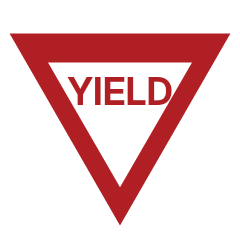
Show answer
Answer A: Pedestrians and cyclists already in or entering the crossing
The duty to give way covers every road user who has the right of way at that point, including people walking or cycling across the driver's path.
-
19. A pedestrian steps off the curb without looking your way. What should you assume?
Show answer
Answer B: That the person has not seen you at all, and be ready to stop for them
Defensive driving means assuming you have not been seen until there is clear evidence that you have.
-
20. A yellow diamond shows two lanes narrowing into one. What does it require of a driver?
Show answer
Answer D: Adjusting speed and merging before the lane disappears
The lane ends sign gives notice that one lane will be dropped, so drivers should adjust speed and blend into the continuing lane in good time.