
New York DMV Motorcycle Practice Test 43
- Questions20
- Correct to pass14
- Passing score70%
- Minimum age16 years
-
1. On a busy multilane highway, where is the best place to travel?
Show answer
Answer B: In a gap in the traffic, with space open on both sides
Travelling in a gap keeps escape routes open on both sides, while riding alongside other vehicles removes the room you would need to swerve.
-
2. The traffic around you is moving well above the limit on a wide highway. What should you do?
Show answer
Answer D: Keep to the limit and stay to the right, letting faster traffic pass
The limit is a legal maximum, and the safe way to differ from the traffic around you is to keep right and let it go by.
-
3. What happens when tires are driven underinflated for a long time?
Show answer
Answer D: They wear at the edges, they run hot and they are more likely to fail
An underinflated tire flexes too much, which wears the shoulders and builds up heat that can destroy the tire.
-
4. You are stopped in a line of traffic on a steep uphill grade. What should you do about the gap to the vehicle ahead?
Show answer
Answer B: Leave more room than usual, because vehicles can roll back as they pull away
A vehicle ahead can roll back a foot or more as its driver releases the brake, and a motorcycle stopped tight behind it has nowhere to go.
-
5. How should a rider dress for a long ride in very hot weather?
Show answer
Answer C: In ventilated riding gear that still covers the arms and legs
Mesh and vented riding gear flows air while keeping its abrasion protection and shading the skin, so heat is not a reason to ride uncovered.
-
6. How should the brake light be checked before a ride?
Show answer
Answer D: Confirm that the hand lever and the foot pedal each switch it on
Many motorcycles use a separate switch for each brake control, so both the lever and the pedal have to be tested one at a time.
-
7. What does a blood alcohol concentration of 0.08 mean for the driver of a car?
Show answer
Answer B: It is the level almost every state treats as legally intoxicated
In almost every state a driver at 0.08 or above is legally intoxicated whatever the driver seems like, but impairment starts well before that level is reached.
-
8. You are waiting to turn left and an oncoming vehicle stopped in the near lane to turn left blocks your view of the far lane. What should you do?
Show answer
Answer A: Wait where you are until you can see that the far lane is completely clear
The lane you cannot see is where the crash comes from, so you hold your position until the view opens up.
-
9. A yellow diamond shows a horse with a rider. Besides slowing down, what else should a driver do?
Show answer
Answer C: Avoid using the horn or revving the engine
The equestrian crossing sign warns of horses on or across the road, and a sudden noise can startle an animal into the traffic lane.
-
10. Why is repeatedly changing lanes to work through heavy traffic a poor idea?
Show answer
Answer A: It raises the crash risk and saves almost no time
Each lane change adds a conflict with another vehicle, and in congestion the lanes move at similar average speeds, so the gain is negligible.
-
11. Why should a rider pull in the clutch at the first sign that the engine is seizing?
Show answer
Answer B: So a locking engine cannot lock the rear wheel through the drive train
A seizing engine can lock up, and with the clutch engaged that would lock the rear wheel, so disconnecting the drive keeps the wheel rolling while you coast off the road.
-
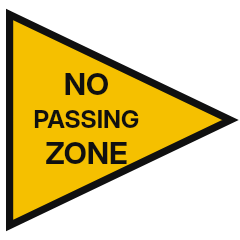
12. A driver is thinking about overtaking a slower vehicle and sees this sign a short distance ahead. What does it mean for that pass?
Show answer
Answer B: The pass must be finished before the restricted section begins
The sign marks the start of a section where passing is prohibited, so a driver may not be on the left side of the road beyond it; any pass has to be completed before that point or not started at all.
-
13. You want to turn left across the oncoming lane into a shopping center driveway. Who must you yield to?
Show answer
Answer B: Oncoming traffic and anyone using the sidewalk
A left turn into a driveway crosses both the oncoming lane and the sidewalk, so you give way to traffic and to pedestrians before completing it.
-
14. May you stop in the striped triangle that separates an exit ramp from the freeway lanes?
Show answer
Answer A: No, it is not a lane and stopping there is dangerous
The striped gore area is not a travel lane or a shoulder, and a vehicle stopped there sits directly in the path of drivers correcting a late exit.
-
15. What should a rider remember about convex mirrors?
Show answer
Answer B: They show a wider view, but vehicles look farther away and slower than they are
The curved glass fits more of the scene into the mirror, and the price of that extra width is a distorted sense of distance and closing speed.
-
16. What is the PRIME position on a fuel supply valve used for?
Show answer
Answer D: To let fuel flow into the carburetor after the machine has stood unused
PRIME bypasses the normal vacuum control and lets fuel refill an empty carburetor, which helps a machine start after sitting for a long time.
-
17. At night you are waiting to turn left and can see only the headlights of an approaching vehicle. Why should you allow a bigger margin?
Show answer
Answer D: Because lights alone make speed and distance hard to judge
With no other visual cues, two points of light give you very little information about how fast the vehicle is closing, so leave extra margin.
-
18. How often should you check your mirrors while driving?
Show answer
Answer C: Every few seconds, so you always know what is around you
Traffic behind and beside you changes constantly. Frequent, brief mirror checks keep a picture of your surroundings current so nothing surprises you.
-
19. A bicyclist ahead of you puts the left arm straight out to the side. What is being signaled?
Show answer
Answer B: A left turn or a move to the left
The left arm held straight out is the bicycle signal for a left turn, so hold back and give the rider room to cross toward the center.
-
20. How does a NO OUTLET sign differ from a DEAD END sign?
Show answer
Answer B: It warns that a whole group of streets has no way out
No Outlet is posted where the road leads into a network of streets from which there is no through route, while Dead End refers to the single street itself.