
New York DMV Permit Practice Test 10
- Questions20
- Correct to pass14
- Passing score70%
- Minimum age16 years
-
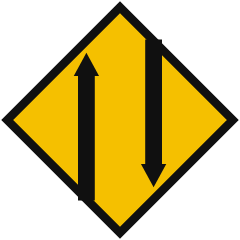
1. Which action becomes clearly more risky beyond this sign?
Show answer
Answer A: Using the left side of the roadway to overtake
With vehicles coming the other way on the same pavement, overtaking on the left needs enough clear road to pull out, pass and return, which is often not available.
-
2. An arrow panel at a work zone displays a flashing arrow pointing to the left. What does it require?
Show answer
Answer C: Move out of the closed lane into the lane on the left
A flashing or sequential arrow on an arrow panel directs traffic out of a closed lane and into the lane the arrow points to.
-
3. Fresh snow covers the road and earlier vehicles have left clear tracks. What line is usually best?
Show answer
Answer B: The existing tracks, where more of the tire can reach the surface
Running in the cleared tracks puts more rubber on the road surface than ploughing through loose snow, provided the tracks have not turned to polished ice.
-
4. What is the maximum fine for a second handheld phone or texting conviction within 18 months in New York?
Show answer
Answer B: $250
New York's tiered fine schedule for phone and texting violations rises to a maximum of 250 dollars for a second conviction within 18 months, up from 200 dollars for a first offense.
-
5. Why is dusk one of the harder times of day to drive?
Show answer
Answer B: The failing light blurs shapes into the background
In fading light there is not enough contrast to pick objects out, yet it is not dark enough for headlights to do the work, so pedestrians and cyclists disappear.
-
6. A large electronic advertising sign beside the road catches your eye. What should you do?
Show answer
Answer A: Glance briefly and return your eyes to the road
Bright changing displays are designed to hold attention, so treat them like any roadside object and give them no more than a brief glance.
-
7. Above what amount of property damage must a New York driver file a crash report with the DMV?
Show answer
Answer B: $1,000
New York requires a crash report when property damage to any one person, including the reporting driver, exceeds 1,000 dollars.
-
8. A diamond-shaped sign is used to
Show answer
Answer A: warn of a condition on or next to the road that may call for caution
The diamond is the standard shape of the warning series, which alerts drivers to conditions that would otherwise not be obvious in time to react.
-
9. You have stopped on the shoulder of a highway and want to rejoin the traffic. What is the correct way?
Show answer
Answer D: Signal, build up speed along the shoulder, then merge into a gap
Entering a fast lane at a slow speed is what causes the conflict, so the shoulder is used to gain speed before the merge in the same way as an acceleration lane.
-
10. A parking space is marked with the international symbol of access. Who may use it?
Show answer
Answer A: Only a vehicle displaying the required placard or plate
Accessible spaces may be used only by a vehicle that displays a valid disability placard or plate, no matter how short the stop would be.
-
11. You want to turn left at an intersection with no signs or signals and a vehicle is coming straight toward you from the opposite direction. What must you do?
Show answer
Answer C: Yield and turn after the oncoming vehicle has passed
A driver turning left always gives way to oncoming traffic that is close enough to be a hazard, whether or not the intersection is controlled.
-
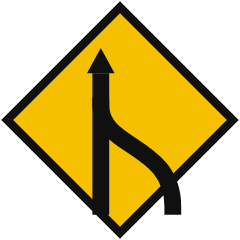
12. What is the safest way to deal with the situation this sign announces?
Show answer
Answer B: Match the speed of the other traffic stream and open a gap so vehicles can blend without hard braking
Blending works when speeds are matched and gaps are opened, so nobody has to brake hard or swerve where the two streams come together.
-
13. A large truck ahead of you swings toward the left just before turning right at an intersection. What should you do?
Show answer
Answer B: Stay back and never try to move into the gap between the truck and the curb
Long vehicles need extra room and often swing wide to complete a right turn, so the space that opens on their right closes again as the trailer sweeps through it.
-
14. You realize your tires are running on ice. Which set of inputs is safest?
Show answer
Answer C: Gentle steering, no sudden braking, and no sudden acceleration
Whatever grip is left is used up at once by any sudden input, so every movement of wheel, brake and accelerator must be slow and small.
-
15. A rectangular red sign with the white words WRONG WAY means that
Show answer
Answer C: the driver is already traveling against the legal flow and must not continue
The wrong way sign uses a white legend and border on red and addresses a driver who has entered a ramp or one-way roadway in the wrong direction, who should stop and turn around safely.
-
16. You are approaching a highway-rail grade crossing marked only with a crossbuck sign. What does that sign require?
Show answer
Answer A: Yield to any approaching train and cross only when the tracks are clear
The crossbuck is a regulatory yield sign, and a train can never stop or steer around a vehicle, so the driver must always give way.
-
17. Once you are moving, which way of using a navigation device costs you the least attention?
Show answer
Answer B: Listening to the spoken directions
Voice guidance lets you keep your eyes on the road, while anything that needs the screen takes glances that add up over a trip.
-
18. At an intersection where turning right on red is permitted and no sign prohibits it, what must you do before turning?
Show answer
Answer A: Come to a complete stop and yield to pedestrians and cross traffic
A right turn on red is allowed only after a full stop, and the turning driver must yield to pedestrians in the crosswalk and to traffic already using the intersection.
-
19. You are following another vehicle down a long, steep grade. What should you do about the gap?
Show answer
Answer D: Make it longer, because both of you need more room to stop
Everything takes longer to stop on a downgrade, including the vehicle ahead, so the gap that works on the flat is no longer enough.
-
20. A large truck ahead of you in a roundabout is using part of both lanes as it goes around. What is the correct response?
Show answer
Answer B: Stay back and give it room until it leaves the roundabout
Long vehicles need extra width to get around the central island, so drivers behind must hold back rather than share the space beside them.