
New York DMV Permit Practice Test 9
Test 9 of 10. Pick an answer for each question to see if it is right and why; your score appears at the end. You need 14 correct answers to pass, the same ratio as the real New York test.
- Questions20
- Correct to pass14
- Passing score70%
- Minimum age16 years
-
1. Under New York's crash reporting law, which drivers are excused from the normal 10 day filing deadline, provided the vehicle's owner has already reported?
Show answer
Answer B: Police officers, correction officers and firefighters operating department vehicles on duty
New York excuses police officers, correction officers and firefighters operating department vehicles while on duty from the ordinary 10 day crash report deadline, as long as the vehicle owner has already filed a report.
-
2. On a long, straight highway you feel your attention fading. What helps you stay alert?
Show answer
Answer A: Keep your eyes moving, scan mirrors and signs, and take regular breaks
Staring at one point brings on highway hypnosis. Active scanning keeps the mind engaged, and a break every couple of hours restores alertness.
-
3. What is New York's minimum no-fault, or personal injury protection, coverage amount per person under a standard auto policy?
Show answer
Answer D: $50,000
New York requires at least 50,000 dollars in basic no-fault, or personal injury protection, coverage per person for medical costs, lost earnings and related expenses.
-
4. Why does even a small reduction in speed matter so much where people are walking?
Show answer
Answer D: Because a pedestrian struck at a lower speed is far more likely to survive
The chance that a pedestrian survives falls steeply as impact speed rises, so a few miles per hour can decide the outcome.
-
5. At what age may a New Yorker enroll in the state Donate Life organ and tissue donor registry through the DMV?
Show answer
Answer B: 16 years old
Under Lauren's Law, a New Yorker may join the Donate Life Registry starting at age 16, typically while applying for or renewing a license or non-driver ID.
-
6. How should your speed behave while you move from one lane into the next?
Show answer
Answer C: Keep it steady or adjust it smoothly to match the traffic in the new lane
A lane change works best as a smooth movement at the speed of the lane you are joining, since sudden braking or acceleration surprises the drivers around you.
-
7. After a New York license revocation period ends, what must the former holder generally do to drive again?
Show answer
Answer D: Reapply for a new license and pay a $100 reapplication fee
Unlike a suspension, a New York revocation cancels the license outright, so the driver must reapply and pay a $100 reapplication fee once eligible, with some exceptions.
-
8. An oncoming driver flashes their headlights while you are waiting to turn left. What should you do?
Show answer
Answer D: Judge the situation yourself, since the flash may mean something else
A flash is not a legal signal and may mean many things, so the decision to turn stays yours and must be based on what you can see.
-
9. A short driver cannot get ten inches between the chest and the steering wheel airbag. What is the answer?
Show answer
Answer D: Move the seat back and tilt the wheel downward, or fit pedal extenders
Distance from the airbag is gained by moving the seat back and aiming the wheel at the chest, using pedal extenders if the pedals are then out of reach.
-
10. How many passengers under 21 may a New York junior license holder carry?
Show answer
Answer D: Only one, unless the extra passengers are members of the immediate family
A junior driver may carry no more than one passenger under 21 unless the additional passengers belong to the immediate family, and everyone must wear a seat belt.
-
11. You are turning left from a two-way street onto a one-way street. Which lane should you enter?
Show answer
Answer C: The first lane open to traffic on the left side of the one-way street
Turn left from the lane closest to the center line and finish in the first available lane on the left of the one-way street, then change lanes if you need to.
-
12. What color light does New York's Move Over law associate with a snow or ice removal vehicle, alongside amber?
Show answer
Answer C: Green
New York's Move Over law lists green, in combination with amber, as an identifying light color for snow and ice removal vehicles, alongside the amber-only option.
-
13. What hearing rights does a New York driver have after being notified of a license suspension for refusing a chemical test?
Show answer
Answer B: A hearing limited to specific issues such as whether the arrest was lawful and whether a refusal warning was given
New York limits the refusal hearing to four issues, including whether there were reasonable grounds for the stop, a lawful arrest, a proper warning, and whether the refusal occurred.
-
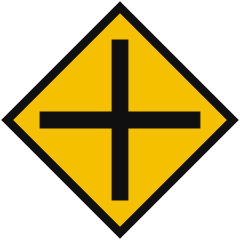
14. What should a driver expect a short distance beyond this sign?
Show answer
Answer C: Another road crossing the one being traveled
Traffic may enter or cross from either side at the intersection ahead, so the driver should ease off, cover the brake and check both approaches.
-
15. Under New York's fine schedule for speeding, how does an active highway work zone change the penalty compared with the same violation elsewhere?
Show answer
Answer D: The fine is doubled compared with the same violation outside the work zone
New York doubles the fine for a speeding conviction in an active highway work zone compared with the identical violation elsewhere.
-
16. A New York driver whose license expired 90 days ago wants to drive before renewing it. What does state law say about the fine for driving on that expired license?
Show answer
Answer B: The fine is higher than it would have been if the license had expired only 30 days earlier
New York sets a lower fine range for a license expired 60 days or less and a higher range once the license has been expired longer than that, so a 90 day lapse falls into the higher bracket.
-
17. Beyond emergency vehicles, which other vehicle type does New York's Move Over law specifically identify by its amber warning lights?
Show answer
Answer A: A hazard vehicle marked with amber lights
New York's Move Over law names hazard vehicles displaying amber lights, alongside tow and recovery vehicles and snow and ice removal vehicles, as protected road users.
-
18. The crossing gates begin to lower while your vehicle is still on the railroad tracks. What should you do?
Show answer
Answer B: Keep going forward and push through the gate if it should block your way
Gates are made to break away, and driving forward off the tracks is far safer than staying between them or backing up.
-
19. What BAC range defines Aggravated Driving While Intoxicated in New York?
Show answer
Answer C: 0.18 percent or higher
New York defines Aggravated DWI as operating with a blood alcohol content of 0.18 percent or more, a more severe charge than ordinary DWI at 0.08 percent.
-
20. A driver stopped on suspicion of impaired driving refuses to take a chemical test. What happens?
Show answer
Answer D: A license penalty follows for the refusal itself
Under implied consent, holding a license means agreeing to testing, so a refusal brings its own suspension separately from anything the court decides.