
New York DMV Permit Practice Test 3
Test 3 of 10. Pick an answer for each question to see if it is right and why; your score appears at the end. You need 14 correct answers to pass, the same ratio as the real New York test.

- Questions20
- Correct to pass14
- Passing score70%
- Minimum age16 years
-
1. What is the maximum gross vehicle weight rating that a New York Class DJ junior license authorizes its holder to operate?
Show answer
Answer A: 10,000 pounds or less
A Class DJ junior license covers vehicles of 10,000 pounds gross vehicle weight rating or less, a smaller ceiling than the 26,000 pound limit that applies to the adult Class D license.
-
2. What point value does New York give to a child safety restraint violation involving a passenger under 16?
Show answer
Answer B: 3 points
A child safety restraint violation for a passenger under 16 carries 3 points in New York.
-
3. A high-occupancy vehicle lane is separated from the general lanes by a pair of solid white lines with a gap every so often. Where may you enter or leave it?
Show answer
Answer D: Only at the openings where the solid lines are broken
The solid lines forbid crossing, so entry and exit are limited to the designated openings where the marking is broken.
-
4. How many points does a conviction for failing to yield the right of way carry on a New York driving record?
Show answer
Answer C: 3 points
Failing to yield the right of way carries 3 points in New York, the same weight as disobeying a traffic control signal.
-
5. Which of these devices falls under New York's portable electronic device law, alongside mobile phones?
Show answer
Answer B: A handheld electronic gaming device
New York's portable electronic device statute defines the term broadly enough to include electronic games, laptop computers and pagers, not just phones.
-
6. Your car has side curtain airbags. What should you avoid doing?
Show answer
Answer B: Resting your head against the window or the door pillar
A side airbag deploys from the pillar or roof rail, so a head leaning against that area is directly in its path.
-
7. What happens to a New York driver convicted of operating an uninsured vehicle?
Show answer
Answer C: The license or driving privilege is revoked for at least one year
Driving an uninsured vehicle, or letting someone else drive yours uninsured, revokes the New York driving privilege for at least one year, and the same applies if the DMV learns of an uninsured crash.
-
8. In Nassau and Suffolk counties, when may a junior license holder drive alone, without a supervising adult, between 5 a.m. and 9 p.m.?
Show answer
Answer D: Only while traveling directly to specific destinations such as school, work or farm work
On Long Island, unlike upstate, unsupervised daytime driving by a junior license holder is limited to direct trips between home and specified destinations such as school, employment or farm work.
-
9. In which crash must the police always be notified?
Show answer
Answer D: Any crash in which somebody has been injured or killed, whatever the damage
Injury or death always makes a crash reportable, whatever the amount of vehicle damage or the opinions of the drivers.
-
10. Why should you set the parking brake even when an automatic transmission is in Park?
Show answer
Answer B: Because it takes the strain off the transmission and holds the vehicle
The parking pawl is a small part carrying the whole vehicle; the parking brake shares that load and holds the vehicle if the pawl fails.
-
11. On a wet road, how should a driver adjust after passing this sign?

Show answer
Answer B: Start braking earlier, because a slippery surface lengthens the stopping distance
A wet surface lengthens stopping distance, so the extra warning distance should be spent braking gently and early instead of late and hard.
-
12. New York requires every auto policy to include uninsured motorist coverage. How are its minimum limits set?
Show answer
Answer A: They must match the policy's own bodily injury liability limits
New York requires uninsured motorist coverage to match the policy's own bodily injury liability limits, and this coverage cannot be waived.
-
13. You are already inside an intersection when you realize you should be in the lane beside you. What should you do?
Show answer
Answer C: Stay in your lane through the intersection and change lanes afterwards
Drivers in an intersection are watching for cross traffic and turning vehicles, so an unexpected sideways move there is easily missed.
-
14. Under New York's phone and texting laws, when may a driver use a handheld device without violating either statute?
Show answer
Answer D: When placing an emergency call to police, fire or a hospital
Both New York statutes exempt calls made to report an emergency to police, fire departments, hospitals or similar emergency services.
-
15. While a junior license holder is driving with passengers in New York, who is allowed to sit in the front seat?
Show answer
Answer D: Only the supervising driver, when one is present in the vehicle
New York restricts the front passenger seat next to a junior driver to the supervising driver, when supervision applies, with all other passengers riding in back.
-
16. At a freeway exit, the paved triangle between the ramp and the through lanes is filled with diagonal white lines. What do they mean?
Show answer
Answer A: Stay out of that area, because it is not meant to be driven on
Chevron and diagonal markings fill paved areas that traffic is not intended to use, so drivers should keep out of them.
-
17. At a freeway exit ramp, this sign normally backs up which other regulatory sign posted nearer to the ramp terminal?
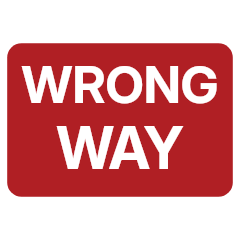
Show answer
Answer D: The sign that forbids entering that roadway at all
The two work as a pair at ramp terminals: one keeps drivers from turning in, and this one sits farther along to catch a driver who has already entered.
-
18. What happens if a junior license holder commits a second serious traffic violation within six months of having a license restored after a first suspension?
Show answer
Answer B: The license may be revoked rather than merely suspended again
A second serious offense within six months of restoration escalates the penalty from a suspension to a revocation under New York's graduated license law.
-
19. What is the safest way to pass a bicyclist on a road with two lanes going your way?
Show answer
Answer D: Change lanes completely, as you would for a car
A bicycle is entitled to the room a vehicle needs, and moving into the next lane gives the rider space to swerve around a drain or a pothole.
-
20. For a first Driving While Intoxicated conviction in New York, what does state law set as the maximum jail exposure alongside the fine and revocation?
Show answer
Answer D: Up to 1 year
A first DWI conviction in New York exposes the driver to a fine of 500 to 1,000 dollars, a license revocation of at least six months, and up to a year in jail.