
New York DMV Permit Practice Test 43
- Questions20
- Correct to pass14
- Passing score70%
- Minimum age16 years
-
1. Your car is sinking after leaving the road into deep water and two children are in the back. In what order should you act?
Show answer
Answer D: Free yourself from the belt first, then release the children, the oldest one first
You cannot help anyone while you are still belted in, and the oldest child released first needs the least help getting out.
-
2. Your vehicle has stalled on railroad tracks and no train is in sight. After getting everyone away, whom should you call first?
Show answer
Answer B: The railroad emergency number posted on the blue sign at the crossing, giving the crossing number
Every public crossing has a blue emergency notification sign with a phone number and a crossing identification number. That call lets the railroad stop or slow trains before they reach you.
-
3. Yellow signs each showing one large black arrowhead, installed in a row along the outside of a curve, are
Show answer
Answer D: chevron alignment signs marking the change of direction of the curve
Chevron alignment signs are placed on the outside of a curve so that several are in view at once, letting the driver judge how sharply the road turns.
-
4. Under New York's phone and texting laws, when may a driver use a handheld device without violating either statute?
Show answer
Answer D: When placing an emergency call to police, fire or a hospital
Both New York statutes exempt calls made to report an emergency to police, fire departments, hospitals or similar emergency services.
-
5. Two vehicles reach a four-way stop at the same moment from adjacent roads. Who should go first?
Show answer
Answer A: The driver on the right
When two drivers stop at a four-way stop at the same time, the driver on the left yields to the driver on the right.
-
6. You are driving on a divided highway and see a solid yellow line along the left side of your lanes. What does it tell you?
Show answer
Answer D: It marks the left edge of the roadway for your direction
On a divided highway or a one-way roadway, the left edge of the traveled way is marked with a solid yellow line.
-
7. Which of these is never a legal place to park?
Show answer
Answer C: In a crosswalk, on a sidewalk or within an intersection
Crosswalks, sidewalks and intersections must stay clear so that pedestrians can cross and drivers can see approaching traffic.
-
8. You are about to make a three-point turn on a narrow two-way street. What is the first step?
Show answer
Answer B: Pull close to the right edge, signal left and check traffic both ways
A three-point turn starts from a stop at the right edge with a left signal, and you only move once you have checked that both directions are clear.
-
9. On a long, straight highway you feel your attention fading. What helps you stay alert?
Show answer
Answer A: Keep your eyes moving, scan mirrors and signs, and take regular breaks
Staring at one point brings on highway hypnosis. Active scanning keeps the mind engaged, and a break every couple of hours restores alertness.
-
10. In heavy stop-and-go traffic, why does using both lanes right up to a merge point help?
Show answer
Answer D: It stores the queue in two lanes, so the backup is shorter
Filling both lanes halves the length of the queue and keeps it away from the traffic upstream, which is why alternating at the merge point works better when traffic is slow.
-
11. On a wet road, how should a driver adjust after passing this sign?
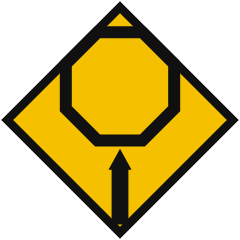
Show answer
Answer B: Start braking earlier, because a slippery surface lengthens the stopping distance
A wet surface lengthens stopping distance, so the extra warning distance should be spent braking gently and early instead of late and hard.
-
12. You are in the middle of an intersection when you hear a siren and see an emergency vehicle approaching. What should you do?
Show answer
Answer A: Keep going, clear the intersection, then pull to the right and stop
Stopping inside an intersection blocks the emergency vehicle. Clear the intersection first, then pull over to the right and stop.
-
13. A snow squall cuts visibility to almost nothing while you are on a highway. What must you not do?
Show answer
Answer D: Stop in a travel lane and wait for the squall to blow through
A vehicle stopped in a lane in a whiteout is invisible until someone hits it. Slow gradually and keep moving until you can leave the roadway completely.
-
14. Why are drivers required to turn the front wheels when parking on a grade?
Show answer
Answer A: So that a vehicle that starts to roll leaves the traffic lanes instead of entering them
The wheel position is a last line of defense if the parking brake or transmission fails, directing the vehicle into the curb or off the roadway.
-
15. Which of these devices falls under New York's portable electronic device law, alongside mobile phones?
Show answer
Answer B: A handheld electronic gaming device
New York's portable electronic device statute defines the term broadly enough to include electronic games, laptop computers and pagers, not just phones.
-
16. Which surfaces usually offer less grip than the pavement around them when wet?
Show answer
Answer B: Painted markings, metal plates and bridge decks
Paint, steel and bridge decks all shed grip when wet or cold, so brake before you reach them rather than on top of them.
-
17. A left-turn bay opens ahead of the intersection with a solid white line beside it. Where should you enter the bay?
Show answer
Answer C: At the opening before the solid line begins
The solid line marks where lane changes are no longer intended, so you move into the turn bay at its opening rather than cutting across the line later.
-
18. How can you check that you are keeping a safe following distance?
Show answer
Answer A: Count at least three seconds between the vehicle ahead passing a fixed object and your reaching it
Pick a fixed roadside object, start counting when the vehicle ahead passes it and make sure at least three seconds elapse before you reach it, adding more time in poor conditions.
-
19. You are traveling beside a tractor-trailer and cannot see the truck driver's face in any of the truck's mirrors. What does that tell you?
Show answer
Answer A: The truck driver probably cannot see your vehicle
Large trucks have deep blind spots on all four sides, so if the driver's face is not visible in a mirror the driver has no view of you. Move ahead or drop back until you are out of that area.
-
20. Why can a motorcycle ahead of you slow down without any warning light showing?
Show answer
Answer B: The rider may slow by downshifting or rolling off
Riders often lose speed by closing the throttle or changing down, which does not switch on the brake light, so watch the machine itself and keep back.