
New York DMV Permit Practice Test 44
- Questions20
- Correct to pass14
- Passing score70%
- Minimum age16 years
-
1. A turn restriction sign at the corner shows a range of times below the symbol. What does that mean?
Show answer
Answer A: The turn is banned only during the hours shown on the sign
Times posted under a regulatory symbol set the period during which the restriction applies; outside those hours the movement is permitted.
-
2. Your vehicle is stuck in deep snow and you run the engine for heat while waiting for help. What must you check?
Show answer
Answer C: That the exhaust pipe is clear of snow
Snow packed around the tailpipe pushes exhaust back into the cabin, and carbon monoxide can kill without warning. Clear the pipe and crack a window open.
-
3. What does a flashing yellow traffic light mean?
Show answer
Answer B: Slow down and proceed with caution
A flashing yellow lets you enter the intersection cautiously after yielding to pedestrians and to conflicting traffic that is already there.
-
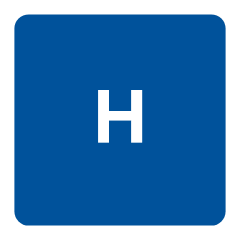
4. Which facility does this sign direct a traveler toward?
Show answer
Answer B: A hospital offering emergency care
This is the standard marker for medical care, used to lead a traveler to a hospital where emergency treatment is available.
-
5. A sign on a long downgrade points to a runaway vehicle ramp. What is that ramp for?
Show answer
Answer C: Trucks that have lost braking ability on the grade
A runaway ramp is an escape lane of loose material that stops a heavy vehicle whose brakes have overheated or failed, so it must always be left clear.
-
6. A lane is marked with a large white bicycle symbol and chevrons, but there is no separate bicycle lane. What does it mean?
Show answer
Answer A: Bicyclists may use the whole lane, so follow or pass with care
A shared lane marking shows that bicyclists and drivers use the same lane and positions riders away from parked car doors, so passing means changing lanes.
-
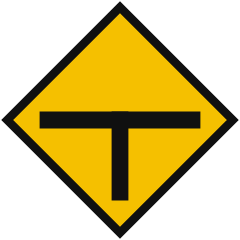
7. What must a driver be prepared to do at the point this sign refers to?
Show answer
Answer D: Turn left or right, because the road being traveled ends there
The road ends at another roadway, so the driver must slow, give way to traffic on the through road and turn in one direction or the other.
-
8. Another driver takes a right of way that was legally yours. What should you do?
Show answer
Answer A: Give way to the other driver and avoid the crash, whatever the law says
Right of way is something you give, not something you take, and being in the right is no protection in a collision.
-
9. About how far behind a tractor-trailer does the driver's rear blind spot reach?
Show answer
Answer C: Around 30 feet
The area behind a large truck is hidden for roughly 30 feet, so a driver tucked in there cannot be seen at all.
-
10. You are traveling at the same speed as a vehicle in the next lane, just behind its rear door. What should you do?
Show answer
Answer B: Change your speed so that you leave that driver's blind spot
That position is the classic blind spot. Slow slightly or move ahead so the other driver can see you before deciding to change lanes.
-
11. You get into a heated argument with a passenger while driving. What should you do?
Show answer
Answer D: End the discussion or pull over to finish it
Anger narrows attention and encourages risk, and a conversation you cannot let go of is a passenger you should be parked to talk with.
-
12. A high-occupancy vehicle lane is separated from the general lanes by a pair of solid white lines with a gap every so often. Where may you enter or leave it?
Show answer
Answer D: Only at the openings where the solid lines are broken
The solid lines forbid crossing, so entry and exit are limited to the designated openings where the marking is broken.
-
13. Your left-turn lane shows a flashing yellow arrow. What does that indication allow?
Show answer
Answer B: A left turn after yielding to oncoming traffic and to pedestrians
A flashing yellow arrow marks a permissive left turn: the movement is allowed, but oncoming vehicles and pedestrians keep the right-of-way.
-
14. How does braking distance change if you double your speed?
Show answer
Answer D: It grows much more than twice as long
Braking distance increases with the square of speed, so doubling speed roughly quadruples the distance needed to stop.
-
15. Why should you avoid parking over tall dry grass or a pile of dead leaves?
Show answer
Answer B: Because the hot exhaust can set the dry material on fire
The exhaust system stays hot for a long time after a drive and can ignite dry vegetation underneath the vehicle.
-
16. Under New York's open container law, in what location may an opened, resealed bottle of wine legally be kept inside a vehicle?
Show answer
Answer C: In the trunk, or behind the last upright seat in a vehicle without a trunk
New York's open container law exempts a resealed bottle of wine kept in the trunk, or behind the last upright seat in a vehicle without a trunk.
-
17. You arrive at a four-way stop after two other vehicles have already stopped there. When is it your turn?
Show answer
Answer A: After both of the earlier vehicles have gone
Vehicles clear a four-way stop in the order they arrived, so the third driver to stop is the third to go.
-
18. You are first in the queue at a red light with a marked crosswalk. Where should your vehicle stop?
Show answer
Answer A: Behind the stop line, so that the crosswalk stays clear
Stopping short of the line keeps the crosswalk usable for people on foot and keeps your vehicle out of the path of turning traffic.
-
19. The light ahead is green but traffic beyond the intersection is backed up. What should you do?
Show answer
Answer B: Wait behind the intersection until there is room to clear it completely
You may not enter an intersection unless you can get completely through it, because stopping inside blocks cross traffic when the signal changes.
-
20. Your light turns green, but a vehicle is still in the middle of the intersection. What should you do?
Show answer
Answer D: Wait until the intersection is clear before you move ahead
A green light means go only when the way is clear. Drivers already inside the intersection must be allowed to finish crossing.