
New York DMV Permit Practice Test 54
- Questions20
- Correct to pass14
- Passing score70%
- Minimum age16 years
-
1. The car ahead drifts across the lane line and back again several times. What should you do?
Show answer
Answer C: Assume that the driver is distracted or impaired, and keep well back
Drifting is a classic sign of a distracted, drowsy or impaired driver, and distance is your protection from all three.
-
2. What term does the New York DMV use for a driver who racks up a series of violations in a short span of time, triggering administrative action?
Show answer
Answer B: A persistent violator
The DMV point system is designed to identify persistent violators, drivers who commit a series of violations within a short period, for suspension action.
-
3. Smoke from a nearby fire is drifting across the highway. What should you do?
Show answer
Answer C: Slow down, use low beams, and close the windows and vents
Smoke cuts visibility like fog and can make your eyes water. Low beams, a much lower speed and closed vents protect both your view and the air in the car.
-
4. You are approaching a multilane roundabout. When should you choose your lane?
Show answer
Answer C: Before you enter, using the lane-choice sign on the approach
You select your lane on the approach the way you would at any multilane intersection, then stay in that lane all the way around, because changing lanes inside a roundabout creates side-impact conflicts.
-
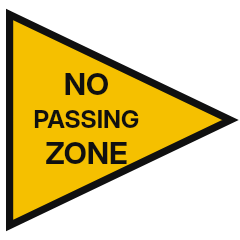
5. Where does the restriction that starts at this sign come to an end?
Show answer
Answer D: Where the centerline markings show that overtaking is allowed again
The sign marks the start of the restricted section, and the centerline markings along the road show how far it runs and where overtaking becomes lawful again.
-
6. A live power line is lying on your car and the car has caught fire, so you must get out. How should you leave it?
Show answer
Answer D: Jump clear without touching the car and ground at once, then shuffle away
Touching the vehicle and the ground together makes you the path to earth, and long strides can bridge the voltage spread through the ground.
-
7. The signal ahead turns yellow while you are approaching it. What does the yellow light mean?
Show answer
Answer C: The red is coming; stop if you can do so safely
A steady yellow warns that the red is next. Stop if you can do so safely; enter the intersection only when stopping would be dangerous.
-
8. A yellow diamond showing two vertical arrows, one pointing up and one pointing down, warns that
Show answer
Answer A: the road ahead carries traffic in both directions
The two-way traffic sign warns that the roadway ahead is not divided and that vehicles will be coming from the opposite direction.
-
9. Which of these does NOT affect how fast alcohol reaches the bloodstream?
Show answer
Answer A: How confident the drinker feels
Food, the strength of the drinks and the speed of drinking all change how fast alcohol is absorbed, but a drinker's confidence changes nothing at all.
-
10. What is the function of a regulatory sign?
Show answer
Answer A: To inform road users of traffic laws or regulations that apply at that location
Regulatory signs state requirements that carry the force of law where they are posted, so disregarding one is a violation rather than a lapse of judgment.
-
11. Someone stops drinking heavily at two in the morning and drives to work at eight. What is true?
Show answer
Answer A: They may still be impaired and over the limit
The body removes alcohol at a slow, fixed rate, so a heavy night can leave a driver impaired well into the next morning no matter how they feel.
-
12. Heavy trucks have worn deep ruts into a highway lane and rain has filled them. What is the danger?
Show answer
Answer D: Water collects in them, so the tires can lose contact with the road
Ruts hold standing water long after the rest of the lane has drained, which makes them the most likely place to start hydroplaning.
-
13. Many signs use a symbol instead of words. The main advantage is that a symbol
Show answer
Answer C: can be read from farther away and by more people
A symbol is recognized at greater distance than a line of text and does not depend on the reader knowing English.
-
14. A sign showing a walking figure carries a plaque below it with an arrow slanting down to the right. What does the plaque add?
Show answer
Answer B: The crossing is at that very spot
A downward-slanting arrow plaque marks the crossing itself, whereas an AHEAD or distance plaque would place it further along the road.
-
15. The sign over the leftmost lane reads LEFT LANE MUST TURN LEFT. You are in that lane and want to go straight. What should you do?
Show answer
Answer C: Move out of the lane before the intersection if it is safe
A mandatory movement lane control sign makes the turn compulsory for that lane, so a driver who wants another movement must change lanes in advance.
-
16. Someone appears seriously injured after a crash. What should you generally do?
Show answer
Answer C: Call for emergency help and avoid moving the person unless there is an immediate danger such as fire
Moving an injured person can worsen spinal or internal injuries, so summon trained help and leave the person in place unless staying there is more dangerous than moving.
-
17. A train has just cleared a crossing that carries two sets of tracks. What should you do?
Show answer
Answer B: Wait and look both ways for a second train
A passing train hides a second train on the other track, so wait until the signals stop and you can see that both tracks are clear.
-
18. A center lane is marked with a broken yellow line on each side and is controlled by overhead lane signals. How is that lane used?
Show answer
Answer A: It carries traffic one way or the other according to the signals
A reversible lane is marked with broken yellow lines on both sides and its direction of travel is set by the lane control signals above it.
-
19. An overhead lane-use control signal shows a steady red X above your lane. What does it mean?
Show answer
Answer B: You may not use that lane and must move out of it
A steady red X means the lane below it is closed to you, while a steady yellow X is the warning to prepare to vacate the lane and a downward green arrow means the lane is open.
-
20. At what age may a New Yorker enroll in the state Donate Life organ and tissue donor registry through the DMV?
Show answer
Answer B: 16 years old
Under Lauren's Law, a New Yorker may join the Donate Life Registry starting at age 16, typically while applying for or renewing a license or non-driver ID.