
New York DMV Permit Practice Test 55
- Questions20
- Correct to pass14
- Passing score70%
- Minimum age16 years
-
1. What does New York's Leandra's Law require after a conviction for driving while intoxicated?
Show answer
Answer A: An ignition interlock device on any vehicle the driver owns or operates for at least 12 months
Courts must order an ignition interlock, paid for by the driver, for at least 12 months on any vehicle owned or operated, and driving intoxicated with a child under 16 aboard can be charged as a felony.
-
2. On a busy multilane highway, where is the best place to travel?
Show answer
Answer B: In a gap in the traffic, with space open on both sides
Travelling in a gap keeps escape routes open on both sides, while riding alongside other vehicles removes the room you would need to swerve.
-
3. Which part of the space around your vehicle can you control best?
Show answer
Answer A: The space ahead of you
You choose your own following distance, so the gap in front is the space you truly control and the one that gives you time to react.
-
4. You have turned onto a street and see parked cars facing you and headlights coming toward you. What has probably happened?
Show answer
Answer C: You have turned the wrong way onto a one-way street
Vehicles parked facing you and headlights approaching in your lane are the classic signs of driving against the flow on a one-way street.
-
5. What are the minimum liability coverage amounts for a vehicle registered in New York State?
Show answer
Answer A: $25,000 bodily injury per person, $50,000 per accident and $10,000 property damage
New York requires at least 25,000 dollars for bodily injury and 50,000 dollars for death of one person, 50,000 and 100,000 dollars for two or more people, and 10,000 dollars for property damage.
-
6. How should a turn at an intersection be taken on a wet road?
Show answer
Answer C: Slow earlier than usual and steer smoothly through the corner
Wet pavement leaves less grip, so the speed must come off before the turn and the steering must be gentle enough not to break traction.
-
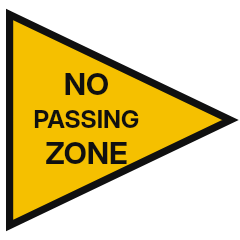
7. A driver is thinking about overtaking a slower vehicle and sees this sign a short distance ahead. What does it mean for that pass?
Show answer
Answer B: The pass must be finished before the restricted section begins
The sign marks the start of a section where passing is prohibited, so a driver may not be on the left side of the road beyond it; any pass has to be completed before that point or not started at all.
-
8. You need to reverse direction on a busy street. Which choice is usually safest?
Show answer
Answer D: Driving around the block and using the intersections instead
Going around the block uses normal turns at controlled intersections instead of stopping across live traffic lanes.
-
9. Is it acceptable to drive far below the flow of traffic on an open highway?
Show answer
Answer B: No, driving too slowly can obstruct traffic and create a hazard
Traffic that is much slower than the surrounding flow forces other drivers into sudden braking and unnecessary passing maneuvers, and impeding traffic is itself a violation.
-
10. What happens to a New York driver convicted of operating an uninsured vehicle?
Show answer
Answer C: The license or driving privilege is revoked for at least one year
Driving an uninsured vehicle, or letting someone else drive yours uninsured, revokes the New York driving privilege for at least one year, and the same applies if the DMV learns of an uninsured crash.
-
11. A driver ahead brakes for no reason you can see, again and again. What should you do?
Show answer
Answer B: Increase your following distance and be ready for yet another stop
Unexplained braking tells you the driver is unsure or distracted, so the safe answer is more room, not less.
-
12. What are painted curb markings mainly used for?
Show answer
Answer D: Conveying parking and stopping regulations
Colored curbs tell drivers where waiting or parking is restricted, and because the exact color meanings are set locally a driver should also read the posted signs.
-
13. Is it acceptable to leave your vehicle across the entrance of an alley for a short time?
Show answer
Answer A: No, the entrance must stay clear at all times
Blocking an alley entrance traps the vehicles inside and can keep emergency services out, so it is prohibited however brief the stop.
-
14. Under New York's crash reporting law, which drivers are excused from the normal 10 day filing deadline, provided the vehicle's owner has already reported?
Show answer
Answer B: Police officers, correction officers and firefighters operating department vehicles on duty
New York excuses police officers, correction officers and firefighters operating department vehicles while on duty from the ordinary 10 day crash report deadline, as long as the vehicle owner has already filed a report.
-
15. You and an opposing driver reach a four-way stop at the same time and both of you are turning right. What should happen?
Show answer
Answer C: Both may turn at the same time into their own lanes
Two opposing right turns take drivers into different lanes without crossing, so both can proceed together once pedestrians are clear.
-
16. What is the purpose of a wide solid white line painted straight across your lane on the approach to an intersection?
Show answer
Answer C: It shows the point where a required stop must be made
A stop line indicates the point at which the stop required by a signal or a stop sign is to be made, ahead of the crosswalk and the intersection.
-
17. What is the lowest speed limit that the authority in charge of a New York highway work area is allowed to post there?
Show answer
Answer B: 25 mph
New York law prevents a work area speed limit from being set below 25 mph, even though it may otherwise be reduced from the normal posted limit.
-
18. You are traveling a long distance on a highway with three lanes in your direction, at about the speed of the surrounding traffic. Which lane is generally the best choice?
Show answer
Answer C: The center lane, which keeps you clear of merging traffic and of overtaking traffic
On a three-lane roadway the center lane avoids both the ramp traffic on the right and the overtaking traffic on the left, so it usually has the steadiest flow.
-
19. What season does New York's DMV identify as when snow tires are legally permitted on vehicles?
Show answer
Answer C: October 16 through April 30
New York permits snow tires from October 16 through April 30 each year, according to the DMV.
-
20. You reach an intersection with no signs, signals or markings clearly before a vehicle that is approaching on your right. What is the rule?
Show answer
Answer B: You may go first because you got there first
At an uncontrolled intersection the first driver to arrive goes first; the yield to the right rule only settles a tie.