
New York DMV Motorcycle Practice Test 59
- Questions20
- Correct to pass14
- Passing score70%
- Minimum age16 years
-
1. Your group reaches a work zone where the lane has been narrowed by cones and the surface is uneven. What should the formation do?
Show answer
Answer B: Move to single file and give each rider the whole width of the lane
A narrowed or broken surface leaves no spare room inside the lane, so riders need the full lane width each and must drop into single file.
-
2. Two vehicles reach a four-way stop at the same moment from adjacent roads. Who should go first?
Show answer
Answer A: The driver on the right
When two drivers stop at a four-way stop at the same time, the driver on the left yields to the driver on the right.
-
3. Two vehicles meet on a steep, narrow mountain road with no room to pass. Which driver should back up?
Show answer
Answer C: The driver heading downhill, who has more control while reversing
On a narrow mountain road the vehicle facing downhill yields, because backing uphill gives better control than reversing down a grade.
-
4. You are following a large truck on a two-lane road and cannot see past it. What should you do before deciding to pass?
Show answer
Answer D: Drop back so that your view of the road ahead opens up
Distance is what buys you a view around a large vehicle, and no decision to pass can be made from a position where you cannot see.
-
5. A broken white line separates your lane from the lane on your right. What does it permit?
Show answer
Answer C: Changing lanes when it is safe to do so
A normal broken white line marks a boundary between lanes traveling the same way that road users may cross when it is safe.
-
6. A sign at the start of an exit ramp shows a speed much lower than the highway limit. What does it apply to?
Show answer
Answer C: The curve of the ramp itself, once you have left the highway
The ramp speed is set by the sharpness of the ramp curve, so you slow to it inside the deceleration lane rather than out on the highway.
-
7. You are starting from a stop on a snowy, icy street and the drive wheels begin to spin. What should you do?
Show answer
Answer C: Ease off the accelerator and start again more gently
Spinning tires polish the surface and dig in. Very gentle pressure on the accelerator, and a higher gear if you have one, gives the tires the best chance to grip.
-
8. On a multi-lane street, a yield line is painted well back from an unsignalized crosswalk rather than right at it. Why?
Show answer
Answer D: So drivers in the other lanes can see the pedestrian
Setting the yield line back keeps a stopped vehicle from hiding a crossing pedestrian from drivers in the next lane, which is a common cause of these crashes.
-
9. Why must a rider turn the head and look before changing lanes?
Show answer
Answer A: Mirrors leave blind spots that only a direct look can cover
Motorcycles have blind spots just as cars do, and a vehicle hidden in one will not appear in the mirrors at all.
-
10. When should a helmet be replaced?
Show answer
Answer B: After a crash, or if the shell is cracked or the straps are frayed
The energy absorbing liner is designed to crush once, so a helmet that has taken an impact or shows damage no longer offers full protection.
-
11. A squirrel darts into your path a short distance ahead. What is normally the safest response?
Show answer
Answer C: Hold your line, brake as much as is safe, and accept hitting a small animal
Swerving without space, or crashing while braking, hurts the rider far more than a small animal does, so stay in your lane and slow as much as traction allows.
-
12. Someone has stepped into a marked crosswalk in the middle of a block ahead of you. What should you do?
Show answer
Answer A: Slow down, stop before the markings and let the person cross the street
A marked mid-block crosswalk carries the same duty as one at a corner: give way to the person crossing, stopping if that is what letting them cross safely takes.
-
13. A train has just cleared a crossing that carries two sets of tracks. What should you do?
Show answer
Answer B: Wait and look both ways for a second train
A passing train hides a second train on the other track, so wait until the signals stop and you can see that both tracks are clear.
-
14. Your navigation device tells you to turn where a road sign says the turn is closed. What should you do?
Show answer
Answer B: Follow the signs and what you can see
A device works from stored data that can be out of date, while signs and the road in front of you show the situation now, so the road wins every time.
-
15. You are about to pass another vehicle at night with your high beams on. What should you do?
Show answer
Answer C: Switch to low beams as you come up behind it and while you are alongside
High beams shining into the mirrors of the vehicle ahead blind the very driver whose reaction you depend on during the pass.
-
16. What are painted curb markings mainly used for?
Show answer
Answer D: Conveying parking and stopping regulations
Colored curbs tell drivers where waiting or parking is restricted, and because the exact color meanings are set locally a driver should also read the posted signs.
-
17. On which approach is this sign normally installed?
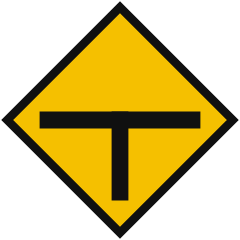
Show answer
Answer C: On the road that ends, far enough ahead for the driver to slow down
The warning belongs on the approach that terminates, placed early enough that the driver can lose speed and choose a direction before reaching the junction.
-
18. You have stopped at a stop line but parked cars hide the cross street. What comes next?
Show answer
Answer C: Edge forward to where you can see, stopping again if needed
The legal stop at the line is only the first stop; you then move up slowly to a point where you can see, and stop again if traffic requires it.
-
19. Why are sign shapes and colors standardized across the whole country?
Show answer
Answer D: So a driver knows the kind of message before reading it
Uniform shapes and colors let a driver classify a sign as regulatory, warning or guide from a distance, before the legend can be read.
-
20. Your light turns green while a pedestrian who started on the walk signal is still crossing in front of you. What must you do?
Show answer
Answer D: Let them finish crossing the road before you move off on your green light
A pedestrian who entered the crosswalk lawfully keeps the right of way until they reach the other side, whatever the signal now shows.